27th Aug 2026
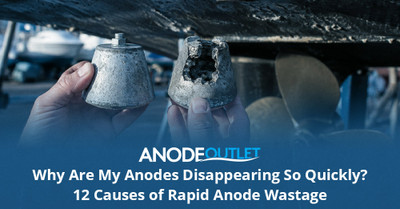
Boat anodes that are disappearing unusually quickly are not simply an inconvenience. They are evidence that the cathodic-protection system is carrying a heavier electrical load than expected, that the wrong anode alloy has been fitted, or that an electrical fault may be driving corrosion. The safest response is to replace any badly depleted anodes, document the wear and investigate the cause rather than fitting larger pieces of metal and hoping the problem goes away.
The most common causes are the wrong alloy for the water, too little anode mass, newly added underwater metalwork, poor coating condition, a broken bonding connection, prolonged shore-power connection, an electrically connected neighbouring structure or vessel, and stray direct current from your own boat. Extremely fast or highly localised destruction deserves urgent professional investigation because stray-current corrosion can damage underwater components far faster than ordinary galvanic corrosion.
This guide provides a practical diagnostic order. For a wider introduction to cathodic protection, start with The Ultimate Boat Anode Guide, then use the checks below to work out why consumption has accelerated.
Safety first
If a propeller, shaft, saildrive, sterndrive, skin fitting or aluminium hull already shows deep pitting, pink or crumbly bronze, coating failure or metal loss, stop treating the issue as routine anode maintenance. Arrange inspection by a competent marine engineer, electrician or corrosion specialist before relying on the boat.
Contents
- Key facts at a glance
- What does normal anode wear look like?
- Twelve common causes of rapid anode wastage
- Diagnose rapid anode wear in the right order
- Check the alloy against the water and the equipment manual
- Shore power, galvanic isolators and stray DC current
- Has the anode been asked to protect more metal?
- Create an anode wear record
- When should you call a marine electrician or corrosion specialist?
- Frequently asked questions
- Technical references
Key facts at a glance
- Anodes are intended to waste, but the rate should be reasonably predictable for the same boat, berth and season.
- A change in wear rate is often more informative than a single end-of-season photograph.
- Magnesium used in salt or brackish water can be consumed extremely quickly and may overprotect some structures.
- Zinc can become inactive in fresh or weakly brackish water; aluminium or magnesium selection must follow the equipment manufacturer and water conditions.
- More stainless steel, a new propeller, rope cutter, trim tab or other connected metal can increase the protection demand.
- Anodes protect only components that are electrically connected to them and exposed to the same electrolyte.
- A galvanic isolator addresses low-voltage galvanic currents through the shore earth conductor; it is not a universal cure for onboard DC leakage.
- Rapid loss on one component but not the rest points towards a local continuity, loading or electrical problem.
- Photographs, initial dimensions, dates, berth details and shore-power usage make diagnosis much easier.
- Replace anodes before they lose the effective mass and shape specified by the equipment manufacturer; many manufacturers use approximately 50% depletion as a replacement point.
Need replacements while you investigate?
Browse anodes by component and alloy, or use a complete bundle where the application is known.
What does normal anode wear look like?
Normal sacrificial-anode wear is usually uneven and cratered rather than perfectly smooth. Water flow, the shape of the anode, local current density and nearby protected metal all influence where material disappears first. A shaft collar may waste differently from a broad hull anode; a small propeller-nut anode may disappear much faster than a large hull block because it has less mass and may protect a highly loaded assembly.
The meaningful benchmark is the same product on the same boat under similar conditions. If an anode previously lasted a full season but is now half gone in six weeks, something changed. That change may be obvious—such as a stainless-steel propeller or a move from a swinging mooring to a marina berth—or hidden, such as a failed wire, damaged cable insulation or shore-earth connection.
| Observed pattern | Likely interpretation | Next check |
|---|---|---|
| Even, gradual cratering over the expected service interval | Usually normal sacrificial action | Confirm the remaining mass and replace at the maker’s stated limit. |
| Whole anode rapidly reduced after moving berth or changing water | Alloy/water mismatch or changed electrical environment | Verify salinity, alloy and shore-power conditions. |
| One drive or shaft anode disappears while others look normal | Local load, loss of continuity elsewhere, extra metal or a local fault | Inspect the complete protected assembly and bonding straps. |
| Anode has deep attack around the fixing but retains an isolated outer shell | Possible poor contact, insert exposure or unusual current concentration | Remove it and inspect the mating faces, fixings and continuity. |
| Anodes and nearby metal both deteriorate rapidly | Protection may be inadequate or a stray-current fault may be present | Arrange electrical and in-water potential testing promptly. |
| Anode consumption accelerates only while connected to shore power | Marina earth path, failed/absent isolation or an onboard fault may be involved | Inspect the shore-power installation and obtain professional tests. |
Twelve common causes of rapid anode wastage
| Cause | Why it increases consumption | What to look for |
|---|---|---|
| 1. Wrong anode alloy for the water | The driving voltage may be excessive for the electrolyte. Magnesium is particularly active. | Confirm whether the boat is in salt, brackish or fresh water and check the equipment manual. |
| 2. Too little anode mass | A small anode must supply the same protective current and is consumed sooner. | Compare the fitted quantity and size with the hull, drive or manufacturer specification. |
| 3. Additional underwater metal | A stainless propeller, rope cutter, trim tabs or other bonded fitting increases the cathodic area. | List every change made since the previous normal season. |
| 4. Damaged protective coatings | Bare drive, hull or underwater metal requires more current from the anodes. | Inspect chips, scrapes, blistering and incorrectly applied antifouling. |
| 5. Long periods on shore power | The protective system may become connected to other boats and marina metalwork through the earth conductor. | Compare plugged-in and unplugged periods; inspect isolation equipment. |
| 6. Failed galvanic isolator or incorrect installation | Low-voltage galvanic current is no longer blocked as intended. | Have the isolator and shore-earth continuity checked to the applicable standard. |
| 7. Onboard stray DC current | Battery current leaking into the water can remove metal extremely rapidly. | Look for damaged pumps, cables, lights, sensors and wiring near bilges or underwater fittings. |
| 8. External stray current | A neighbouring vessel, dock equipment or submerged structure may alter the local electrical field. | Note whether wear changes by berth and ask the marina to investigate credible evidence. |
| 9. Broken or altered bonding | One small anode may be left carrying a larger assembly, or current may follow an unintended path. | Inspect straps, wires, fasteners and flexible-coupling bridges. |
| 10. Poor-quality or incorrect replacement | Wrong chemistry, dimensions or exposed area can change performance and life. | Use a traceable, application-correct anode from a reputable manufacturer. |
| 11. The anode is only partly immersed | The effective exposed area changes and protection may be concentrated unpredictably. | Check drive trim, waterline and whether the anode remains submerged at the berth. |
| 12. More time afloat or warmer, more conductive water | Exposure time, salinity, temperature and water movement all affect reaction rate. | Compare like-for-like operating periods, not calendar age alone. |
Diagnose rapid anode wear in the right order
Start with the simple, observable causes before altering the protection system. A disciplined sequence prevents an electrical fault being disguised by fitting larger anodes.
- Record the evidence. Photograph every anode and nearby protected component before cleaning. Note the date fitted, estimated percentage lost, berth, water type and shore-power use.
- Identify the exact anode. Confirm its part number, alloy, dimensions and intended equipment. Colour alone is not a reliable alloy test.
- Confirm the water. Estuaries and tidal rivers can vary substantially with rainfall and tide. Use the manufacturer’s alloy recommendation for the actual operating range.
- Review changes. Include new propellers, drives, rope cutters, trim tabs, hull repairs, antifouling, chargers, shore leads and neighbouring berth arrangements.
- Inspect installation and continuity. Look for paint, scale, loose fasteners, failed straps and flexible couplings that interrupt the intended electrical path.
- Check the protected metal. Anode loss without damage may indicate heavy but successful protection; anode loss with pitting means the system needs urgent assessment.
- Investigate shore power and DC systems. This should be done by a person competent in marine electrical testing when rapid or unexplained loss is present.
- Measure in-water potentials where necessary. A suitable reference electrode and correct procedure reveal far more than resistance testing ashore.
Do not diagnose by appearance alone
Resistance or continuity checks can confirm that a conductive path exists, but they do not prove that the boat is correctly protected in the water. A corrosion specialist may need to measure hull or component potential against a reference electrode.
Check the alloy against the water and the equipment manual
Anode choice is not simply “zinc for boats”. Modern systems may specify aluminium anodes for salt and brackish water, magnesium anodes for fresh water, or a particular OEM alloy for a drive or engine. Zinc anodes remain appropriate for many saltwater applications, but can passivate in fresh or weakly conductive water.
The exact recommendation of the engine, drive, propeller or hull-system manufacturer takes priority. For example, current Volvo Penta guidance recommends aluminium in salt and brackish water and magnesium in fresh water for the products covered by its guidance. Other equipment may use different approved choices. Never swap alloy merely because another material appears to last longer: an anode that lasts because it is inactive is not protecting the component.
| Situation | Possible rapid-wear explanation | Correct response |
|---|---|---|
| Magnesium fitted in salt or brackish water | Very high activity and possible overprotection | Replace with the manufacturer-approved salt/brackish alloy and inspect coatings and protected metal. |
| Correct alloy, but boat moved to a more saline berth | Higher water conductivity increases current demand | Monitor more frequently and verify system sizing. |
| Mixed alloy types on one bonded system | The more active alloy may protect the other anode as well as the boat | Return to one compatible, manufacturer-approved system unless the OEM expressly specifies otherwise. |
| Anode marked correctly but provenance unknown | Alloy composition or casting quality may be unsuitable | Use traceable, specification-compliant replacements. |
Shore power, galvanic isolators and stray DC current
Galvanic corrosion and stray-current corrosion are related to electrical current, but they are not the same fault. Galvanic current is generated naturally when dissimilar electrically connected metals share an electrolyte. Stray-current corrosion is driven by an external electrical source—commonly a DC system fault—and can be dramatically faster.
When a boat is connected to shore power, its protective earth conductor can connect its underwater metals to a much larger network. A correctly selected and installed galvanic isolator is intended to block low-voltage galvanic currents while retaining the safety-earth function under fault conditions. It must be installed and tested correctly. It does not repair damaged DC wiring, and it should never be bypassed or improvised.
Warning signs for possible stray current include severe loss over days or weeks, sharply localised pitting, damage centred near an electrical fitting, an abrupt change after electrical work, or ongoing metal loss despite correctly sized fresh anodes. Isolate the boat only in a safe, standards-compliant manner and bring in a qualified marine electrician. Do not disconnect protective earth as an experiment.
Review shore-power protection
Browse purpose-designed galvanic isolators, then have the installation selected and verified by a competent person.
Has the anode been asked to protect more metal?
Cathodic protection is a system. A new stainless-steel propeller, folding propeller, rope cutter, trim tab, transducer housing or added underwater fitting can alter the galvanic balance. Damage to the protective paint on an aluminium drive or steel hull can have the same effect because a larger bare-metal area now needs current.
Component-specific anodes are normally designed for the original assembly. A small saildrive anode should not automatically be expected to protect an aftermarket propeller and rope cutter as well as the drive. Likewise, an anode on a sterndrive may be depleted more quickly after stainless accessories are installed. Follow the drive and accessory manufacturers’ instructions; some installations require a purpose-made additional or modified anode arrangement.
Do not bond every piece of metal together without a design. Bonding can bring a component under anode protection, but it can also enlarge the system and create new current paths. Changes should be assessed as a whole rather than treated as isolated fittings.
Create an anode wear record
A simple record turns guesswork into evidence. Photograph anodes when new, after the first month, at mid-season and at lift-out. Include a ruler in the image and take the same angle each time. Weigh removable anodes if practical and record original and remaining dimensions.
| Record | Why it helps |
|---|---|
| Exact part number and alloy | Confirms like-for-like comparison and prevents accidental material changes. |
| Date installed and date inspected | Allows consumption to be expressed per month or per period afloat. |
| Estimated remaining mass or dimensions | Shows whether the rate is accelerating. |
| Shore-power connection history | May reveal a strong relationship with plugged-in periods. |
| Water type, berth and nearby structures | Helps identify environmental changes. |
| Electrical, paint and underwater hardware changes | Links an abrupt increase to a possible cause. |
| Photographs of protected components | Shows whether anodes are succeeding despite heavy wear or whether damage continues. |
If you need to replace several component anodes at once, a correctly matched anode bundle can reduce omissions. The bundle still needs to match the exact model, serial range, water type and fitted accessories.
When should you call a marine electrician or corrosion specialist?
- An anode loses a substantial proportion of its mass in days or a few weeks.
- Protected metal shows active pitting, pinking, dezincification, exfoliation or coating failure.
- Wear changes sharply when shore power is connected.
- The problem began after electrical work, a new charger, pump, transducer or underwater light was installed.
- Different components give contradictory signs—some anodes vanish while others remain untouched.
- You suspect a marina or neighbouring vessel but have no controlled measurement to prove it.
- The boat has an aluminium or steel hull, an impressed-current system, or a complex bonding arrangement.
- You need reference-electrode testing or interpretation of cathodic-protection voltage.
Bring your photographs, part numbers and timeline. A good investigator needs to know what changed and how quickly. The existing Anode Outlet guide to cathodic-protection voltages provides useful background, but in-water testing must be performed and interpreted correctly for the hull material and equipment.
Frequently asked questions
How quickly should a boat anode wear?
There is no universal number of months. Alloy, water conductivity, anode size, exposed metal, coating condition, berth, shore power and time immersed all matter. Use the previous wear rate on the same boat as a baseline and inspect frequently enough that the anode cannot disappear between checks.
Does fast anode wear mean the anode is working well?
It proves that the anode is supplying current, but not that the overall situation is healthy. Heavy but controlled consumption can protect the boat; extreme consumption may signal incorrect alloy, insufficient mass or an electrical fault.
Will fitting a larger anode solve the problem?
A larger anode may increase service life in a correctly designed system, but it must not be used to conceal stray current, wrong alloy or damaged coatings. Diagnose the cause first.
Can another boat make my anodes disappear?
A neighbouring fault or shared marina earth network can influence the electrical environment, but this should be demonstrated through competent testing rather than assumed. Your own boat’s wiring and protection system must be checked as well.
Should I disconnect shore power to stop anode loss?
Do not defeat safety systems or disconnect protective earth. A qualified marine electrician can test the installation, galvanic isolator and onboard circuits and advise on safe operating arrangements.
Why is only my propeller anode wearing quickly?
The propeller assembly may have a high local protection demand, added stainless components, limited anode mass or a continuity issue elsewhere. Confirm the exact propeller, shaft or drive arrangement and use the purpose-made anode.
Technical references
Product manuals and model-specific service instructions take priority over general guidance.