30th Oct 2026
A saildrive can require more than one sacrificial anode: a ring or collar protecting the drive leg, a separate anode on the propeller hub, and sometimes a purpose-made anode for a rope cutter. The correct combination depends on the exact saildrive model, propeller make and model, fitted accessories, water type and production version. A ring that fits the leg may still be wrong if it clashes with a rope cutter or leaves the propeller unprotected.
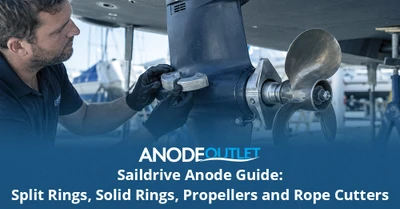
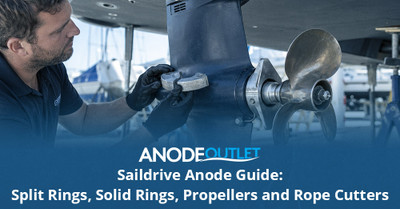
Split-ring anodes can usually be fitted around the drive without removing the propeller, while solid rings normally require the propeller or adjacent hardware to be removed. That convenience does not make split and solid rings interchangeable: the drive and accessory manufacturer must approve the design and fixing arrangement.
Start in the saildrive anodes category, then narrow by brand, model and ring type. Use this guide to identify every protected component before ordering.
Protect the aluminium drive coating
Never paint an anode, use copper- or tin-containing antifouling on an aluminium saildrive, or remove more factory coating than the manufacturer specifies. Coating damage increases the metal area the anode must protect.
Contents
- Key facts at a glance
- Map the complete saildrive protection system
- Split-ring vs solid-ring saildrive anodes
- Identify the saildrive before identifying the anode
- Do saildrive propellers need separate anodes?
- How do rope cutters affect saildrive anodes?
- Which saildrive anode material should you use?
- Saildrive anode inspection at lift-out
- High-level saildrive anode replacement process
- What unusual saildrive-anode wear means
- Frequently asked questions
- Technical references
Key facts at a glance
- The engine model and saildrive model are not always the same identification problem; record both.
- A saildrive ring normally protects the drive housing, not automatically every propeller or rope-cutter component.
- The propeller may have its own hub, cone, button or blade-system anode.
- Split rings and solid rings differ in installation, shape, fixing and sometimes effective mass.
- Aftermarket rope cutters can require a modified ring, spacer or separate sacrificial part.
- Bronze, composite, aluminium and stainless propellers change the galvanic system differently.
- Use only the alloy approved for the exact drive and water type.
- Keep anodes bare and contact faces clean while preserving surrounding drive coatings.
- Inspect ring bolts, propeller-anode screws and accessory fasteners for loss of retention.
- Rapid ring loss, drive pitting or an untouched anode requires investigation rather than routine replacement alone.
Choose by drive brand and ring type
Browse model-specific rings for Volvo and Yanmar saildrives, then check the propeller and rope cutter separately.
Map the complete saildrive protection system
| Part of the installation | Typical anode arrangement | Identification required |
|---|---|---|
| Saildrive leg | Ring, collar, segmented ring or model-specific body anode | Drive model, generation/serial, fixing pattern and water type. |
| Standard fixed propeller | Propeller-nut, cone or hub anode where specified | Propeller and drive model, shaft/hub interface and blade clearance. |
| Folding propeller | Brand-specific hub buttons, ring, cone or multiple small anodes | Manufacturer, exact model, blade count, hub generation and saildrive fit. |
| Feathering propeller | Flat or conical hub anode, sometimes separate from drive ring | Propeller brand/model and available aft clearance. |
| Rope cutter | Modified saildrive ring, dedicated cutter anode or approved supplementary arrangement | Cutter make/model and exact saildrive/propeller combination. |
| Bonding or supplementary hull anode | Only where the system designer/manufacturer specifies it | Electrical connection, hull arrangement and in-water protection assessment. |
Treat these as connected but distinct subassemblies. A fresh drive ring does not compensate for an absent folding-propeller anode, and a propeller anode cannot be assumed to protect the painted drive leg.
Split-ring vs solid-ring saildrive anodes
| Feature | Split-ring anode | Solid-ring anode |
|---|---|---|
| Construction | Two or more sections clamped around the drive | One continuous ring |
| Routine access | Often fitted without removing the propeller | Normally requires removal of adjacent propeller hardware |
| Fixing | Multiple joining/fixing screws and precise mating faces | Model-specific retaining arrangement |
| Installation risk | Misaligned halves, trapped paint/debris or uneven bolt tightening | Incorrect reassembly of propeller or spacer system |
| Compatibility | May be designed for later drive versions or rope-cutter access | May be original arrangement on earlier or specific models |
| Selection rule | Use only where listed for the exact drive/accessories | Use only where listed for the exact drive/accessories |
Browse split-ring saildrive anodes or solid-ring saildrive anodes after confirming the drive model. Do not convert from solid to split solely to avoid propeller removal unless an approved conversion part exists.
Identify the saildrive before identifying the anode
- Find the drive identification plate or stamped details. Do not use the engine badge alone.
- Record the full model and serial range. Examples within one brand can use different ring diameters and bolt patterns.
- Photograph the drive before dismantling. Include the ring, propeller, rope cutter and any spacers.
- Record the propeller separately. Note manufacturer, model, blade count and whether it is fixed, folding or feathering.
- Identify every accessory. Rope cutter make and model are especially important.
- Check the water type. Use the drive manufacturer’s approved anode alloy.
- Compare part numbers and dimensions. Verify inner/outer diameter, thickness, split line, locating profile and hole pattern.
For common product paths, browse Volvo saildrive anodes or Yanmar saildrive anodes. The existing Volvo Penta anode guide adds model-family context.
Do saildrive propellers need separate anodes?
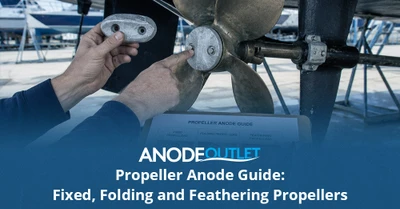
Often, yes. Folding and feathering propellers contain hubs, gears, pins and dissimilar metals that are not necessarily protected adequately by the drive ring. Manufacturers therefore fit dedicated anodes in locations that maintain contact with the propeller assembly.
Select the propeller anode by the exact propeller model, not just by the saildrive. For example, a propeller can remain on the same Volvo or Yanmar drive after a later upgrade, creating a combination that differs from the original engine package. Browse model-specific propeller anodes, including Darglow, Gori and Bruntons ranges.
| Propeller observation | Possible cause | Action |
|---|---|---|
| Propeller anode gone but drive ring remains | Small anode mass or high propeller demand | Shorten inspection interval; verify exact propeller anode and alloy. |
| Drive ring gone after stainless/bronze propeller upgrade | Drive system is carrying additional galvanic load | Check manufacturer guidance for supplementary or revised protection. |
| Hub anode loose | Incorrect screws, thread treatment, torque or seating | Inspect threads and refit with the exact specified hardware. |
| Propeller shows pinking or pitting | Anode missing, inactive, isolated or insufficient | Stop routine service and assess the propeller and electrical path. |
How do rope cutters affect saildrive anodes?
A rope cutter occupies space around the drive or propeller shaft and may introduce stainless-steel or other metal components. Some cutters require part of the standard ring to be removed or replaced by a purpose-made split anode. Others have their own sacrificial component or are designed to work with a specific propeller anode.
Never cut, drill or thin a standard saildrive anode without the rope-cutter manufacturer’s approved pattern. Reducing mass can shorten service life, and altering contact faces can prevent correct mounting. Darglow, for example, supplies model-specific HydroAxe anodes for defined Volvo and Yanmar saildrive combinations.
Record the complete combination
When ordering, state the saildrive model, propeller make/model and rope-cutter make/model. “Anode for a Volvo saildrive” is not enough once aftermarket hardware is fitted.
Which saildrive anode material should you use?
Use the drive manufacturer’s current guidance. Modern Volvo Penta guidance recommends aluminium for its products in salt and brackish water and magnesium for fresh water, with zinc used where an aluminium product is not provided. Current Yanmar saildrive instructions for relevant models specify aluminium in salt and brackish water and aluminium or magnesium for optimum fresh-water applications, while warning against magnesium in salt or brackish water.
Those examples are not permission to generalise across every drive and accessory. Propeller and rope-cutter manufacturers may specify their own compatible material. Keep the anode system consistent unless the equipment maker explicitly designs a mixed arrangement.
| Operating water | Selection principle | Risk to avoid |
|---|---|---|
| Salt water | Use approved aluminium or zinc product for the exact assembly | Magnesium can be consumed extremely rapidly and cause overprotection. |
| Brackish/estuarine | Approved aluminium is commonly specified | Zinc can become less reliable as salinity drops. |
| Fresh water | Use the approved magnesium or other specified fresh-water option | Do not assume a saltwater ring remains active. |
| Regularly changing water | Follow the widest approved range and monitor frequently | Leaving an inactive or overly active material fitted for long periods. |
Saildrive anode inspection at lift-out
- Photograph the ring, propeller and rope cutter before pressure washing.
- Estimate remaining mass and look for uneven loss, cracks or missing sections.
- Inspect every fixing screw and the joint between split-ring halves.
- Check drive paint for chips, blistering, copper contamination and corrosion at edges.
- Inspect propeller and cutter anodes independently.
- Look for damaged continuity or grounding connections identified in the drive manual.
- Compare wear with the previous lift-out and note time afloat and shore-power use.
- Replace any anode unlikely to last until the next planned inspection.
Drive manufacturers commonly recommend replacing anodes when approximately half consumed, but a small propeller or ring section may need earlier replacement if the remaining shape cannot stay secure. If loss is rapid, investigate the system before simply fitting another ring.
High-level saildrive anode replacement process
The exact procedure varies. Propeller removal can involve locking devices, cones, spacers, blade mechanisms and torque settings that are safety-critical. Use the current saildrive, propeller and rope-cutter manuals together.
- Secure the boat and prevent engine starting or propeller rotation.
- Document the order and orientation of propeller parts, spacers and cutter components.
- Remove the old anode without damaging the aluminium drive or threads.
- Inspect hidden contact faces, fixing holes and coating condition.
- Clean only the specified electrical-contact surfaces; retain surrounding protective coating.
- Dry-fit the exact replacement and confirm clearance to blades, cutter and drain openings.
- Use new specified fasteners, locking compounds and torque values.
- Reassemble the propeller system exactly, renew locking devices where required and verify free movement.
- Apply only drive-approved coatings, keeping the anodes and required clearance completely bare.
- Photograph the finished system and add part numbers to the service record.
Complete the saildrive service
Select the drive ring first, then verify whether the propeller and rope cutter require separate anodes.
What unusual saildrive-anode wear means
| Finding | Likely checks |
|---|---|
| Ring disappears in a few months | Wrong alloy, damaged drive coating, additional prop/cutter metal, shore-power or stray-current problem. |
| Ring remains untouched but drive pits | Paint/scale at contact faces, wrong alloy, broken electrical path or passive anode. |
| One half of split ring wastes much faster | Uneven contact, shielding, loose fixing or local damage. |
| Ring cracks around bolts | Overtightening, poor seating, impact or advanced internal wastage. |
| Propeller anode vanishes while ring is normal | High local propeller demand or insufficient small-anode mass. |
| New rope cutter coincides with faster wear | Changed galvanic load or wrong modified-anode arrangement. |
If the aluminium drive casing itself shows pitting, do not relaunch after a cosmetic paint touch-up alone. Obtain drive and corrosion expertise to assess metal loss and the complete protection system.
Frequently asked questions
Can I fit a split-ring anode instead of a solid ring?
Only when a part is approved for the exact drive model and accessories. Similar dimensions do not prove equivalent mass, contact or retention.
Do I need to remove the propeller to change a split ring?
Often not, which is a key benefit, but access and procedure vary. Follow the drive and accessory instructions.
Does the saildrive ring protect my folding propeller?
Do not assume so. Most proprietary folding or feathering propellers have their own specified anodes.
Can I paint around the saildrive anode?
Use only drive-approved coating and respect the maker’s bare-metal/anode clearance. Never paint the anode itself.
Why did my saildrive anode wear faster after fitting a rope cutter?
The cutter can add metal, alter the standard ring and change exposed anode mass. Verify the approved cutter-specific arrangement.
Can a saildrive anode be changed underwater?
Some split products may physically permit it, but underwater work has risks and may prevent correct cleaning, inspection and torque. Follow the manufacturer and use a competent diver where applicable.
Technical references
Use current manuals for the exact drive, propeller and rope cutter.